Equinox Louvered Roof and Apollo Opening Roof (that’s us) are both leading custom louvered roof manufacturers, and we are more alike than not. Both of our systems are motorized, adjustable, aluminum, custom-sized, and installed through dealers. If you are choosing between us, what helps is knowing where we genuinely differ. This page walks through the louver, the structures each system can be built into, how the warranties compare, how each one handles weather, and the two companies behind them, side by side.
Cards on the table
Two close competitors, compared honestly.
Apollo and Equinox sit in the same category: motorized, adjustable aluminum louvered roofs, custom-sized and installed through dealers. Equinox makes a genuinely good system and has for years, so this is not a list of reasons to avoid it. It is a straight comparison of where the two of us actually differ, on the louver itself, the structures each system can be built into, how the warranties compare, how each one handles weather, and the two companies behind them. Read it through, then decide what fits your project.
At a glance
Same category, built and backed differently.
Both systems open and close adjustable aluminum louvers over your patio. The differences worth weighing are in how the louver is built and pivots, what shapes and attachments each system can be engineered into, how each one drains, how the warranties compare, and who makes and sells them. Here is the side-by-side, with genuine advantages on both sides.
| Feature | Apollo Opening RoofCustom, dealer-installed system | Equinox Louvered RoofCustom, dealer-installed system |
|---|---|---|
| System type | Motorized adjustable louvered roof, custom-sized, engineered per site | Motorized adjustable louvered roof, custom-sized |
| Shapes & layout | Angles, corners, L-shapes, and custom sizes | Angles, corners, L-shapes, and custom sizes |
| Structural reach | ✓Cantilevers with no posts in the run, plus integration into existing steel or timber | Standard post-and-beam layouts |
| Hybrid & solid-panel roofs | ✓Mix louvered sections with solid insulated or flat-pan panels in one roof | All-louvered bays |
| Beam options | ✓2x8 and 2x10 structural beams, plus 2x6, 2x4, and 2x2 accent beams | 2x8 or 4x8 beams |
| Post options | ✓4x4, 6x6, and 8x8 posts | 4x4 and 7x7 posts |
| Fascia | ✓Standard or stepped fascia for a layered look | Standard fascia |
| Louver size | Large 8" blades | Large 8" blades |
| Louver construction | Single solid extrusion, heavier blade built for strength and impact | Double-walled hollow blade, 0.065" wall (about 1/16"), built for insulation |
| Louver alloy & temper | 6063-T6 aluminum | 6063-T6 aluminum |
| Louver profile | ✓Flat tongue-and-groove appearance (finished-ceiling look) | Insulated adjustable blade |
| Louver pivot | ✓Delrin pivot and control pins, no metal-on-metal contact | Louvers ride on pivot strips, driven by a gear or linear motor through a link bar |
| Louver span | Louvers to 11'6", less at higher wind and snow loads | Louvers to roughly 14 ft per run, less at higher wind and snow loads |
| Frame & finish | Extruded aluminum, powder-coated | Extruded aluminum, powder-coated |
| Engineering | ✓Published span tables by wind and snow load. Plans stamped by a licensed engineer in your state when requested | Published span tables by wind and snow load; Miami-Dade certified per Equinox |
| Smart control | Somfy remote standard. TaHoma app and weather sensors available | GAMA remote standard, optional Somfy RTS, Bond app control |
| Integrated lighting | ✓Elios recessed LED designed for our systems, dimmable | Accessory lighting |
| Rain management | ✓6" perimeter gutter on all sides, plus internal downspouts routed through the posts | 5.5" gutter with downspout |
| Weather-tightness | Directs water away; not marketed as waterproof | Marketed as watertight when closed (warranty excludes weather-tightness) |
| Colors | 5 standard colors plus custom colors and specialty finishes | 5 standard colors plus custom |
| Dealers & availability | Certified Apollo dealers located across the US | Dealers located throughout the US, Canada, and Mexico |
| Pricing | Custom, designed and quoted per project | Custom, designed and quoted per project |
| Made in | ✓Roseville, Northern California, USA | Amerimax (OmniMax), Norcross, Georgia, USA |
COMPARE YOUR QUOTE
Already have a price from Equinox? Get one from us and compare.
Both systems are custom-sized, engineered to your space, and quoted through a dealer, so neither one has a shelf price. That also means a quote only tells you something when it is for the same project: the same space, the same loads, the same options. Send us what Equinox quoted and we will put together an Apollo quote for your build, so you can compare the louver, the configuration, and the warranty behind the price, not just the figure at the bottom.
Configuration
Designed for your space, not a standard footprint
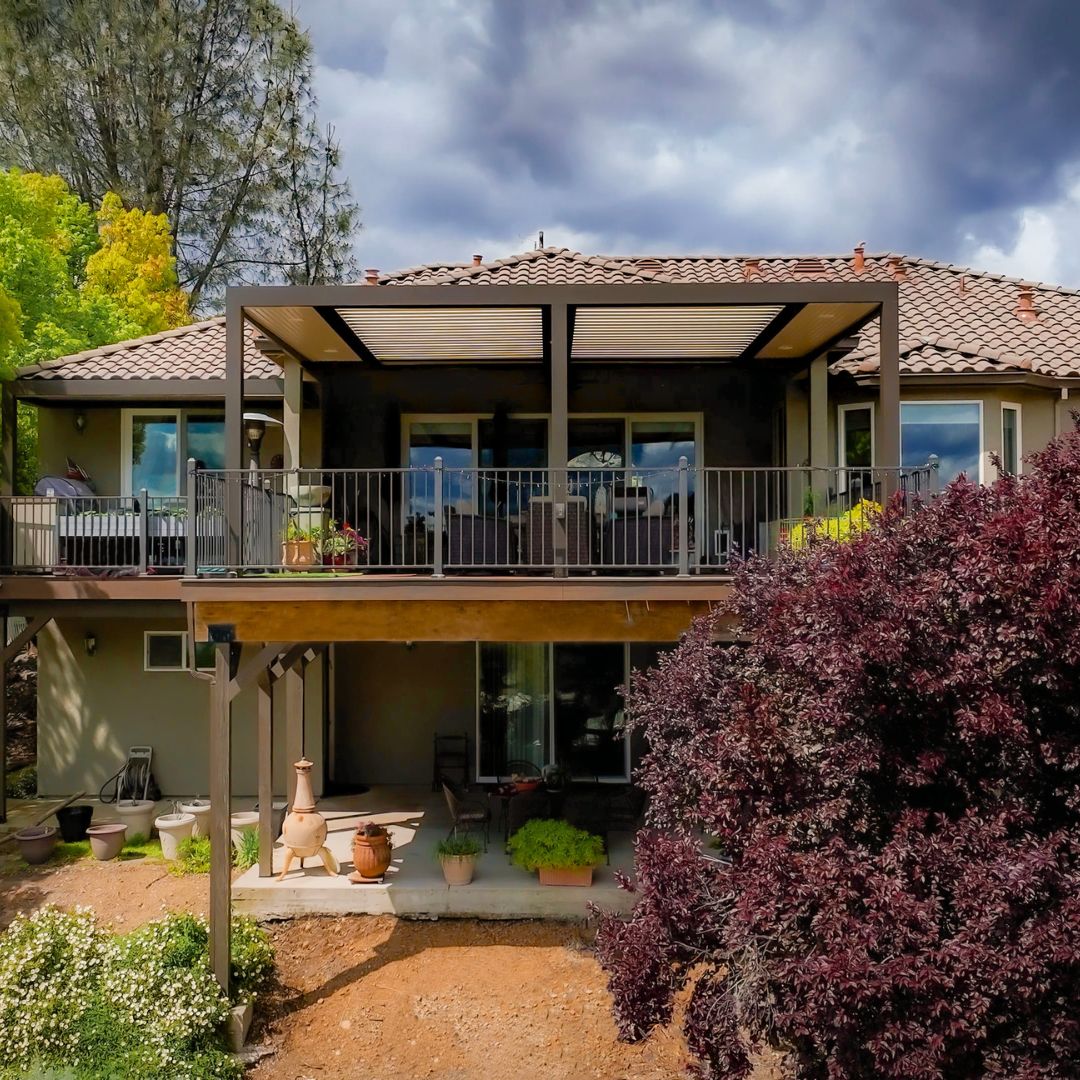
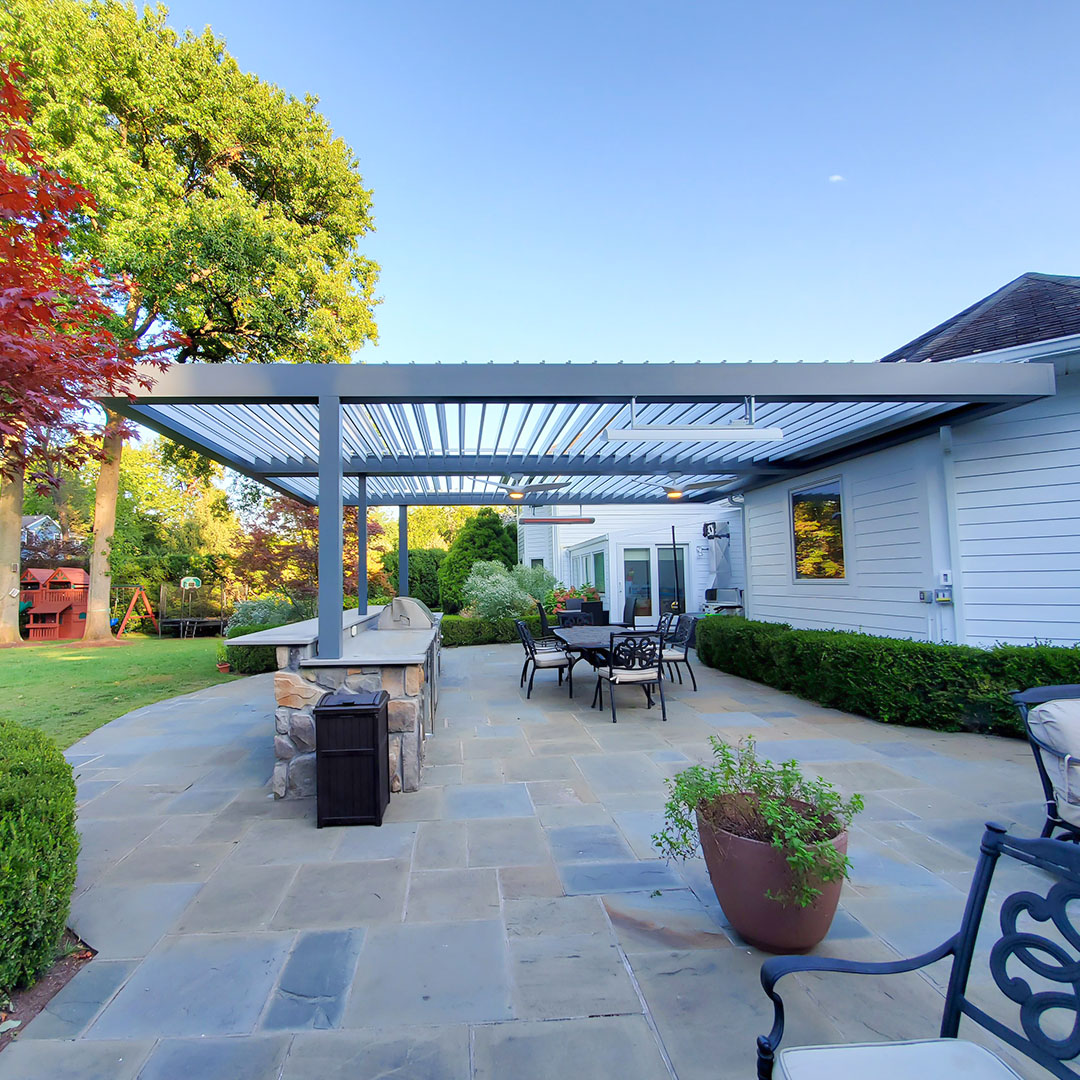
Both systems are genuinely customizable, theirs and ours. Equinox sizes to your space, wraps corners, and works at angles, and for a lot of patios that is everything you need. Where we go further is the kind of structure we can engineer around your site: cantilevered sections with no posts in the way, and roofs that tie into existing steel or timber.
The bigger difference is what goes in the roof. We can mix roof types in one structure, louvered sections for light and air alongside solid insulated or flat-pan panels where you want full shade and cover. Equinox is all louvers, which is one surface; ours can be both. And because our 360° perimeter gutter runs all the way around, even a cantilevered section still drains, with internal downspouts routed down through the posts so you never see them.
One honest constraint worth knowing on either system: a louvered blade can only span so far before it needs support. Equinox publishes louver runs to about 14 feet. Ours run to 11’6″, and the exact length depends on the wind and snow loads your site has to carry, so we size the beams and posts to match. For very wide openings, both of us solve it the same way, with structure, just laid out differently.
Engineering
Engineered for your site, stamped for your state
Both systems are engineered to carry wind and snow load, and the framing aluminum is similar across most louver companies (both run roughly 1/8″ extruded beam walls). Where we have put years of focus is the connection details, beam to beam, post to beam, and post to concrete, worked out with our dealers to make the build simpler for the installer and the finished structure stronger.
There is also a difference in how each system reaches your site. Every Apollo system is CNC precision-cut, fabricated, finished, and crated for its specific install before it ships. Equinox is field-assembled: beams are cut to length on site and joined with insert channels or corner brackets using self-tapping Tek screws, and louvers are cut to length and end-capped on site. Both are installed by pros; one arrives built for your job, the other is built on the patio.
Engineering is there when your project needs it. We can engineer the system for the structure it attaches to and the conditions where you live, and provide plans stamped by a licensed engineer in your state. We do not require it on every job, but when your permit office asks for it, or you just want the assurance, that stamped plan shows the system was designed for your actual site rather than signed off against a general product rating.
Louver design
A solid blade, a finished-ceiling look, and a quiet pivot
Both of us use large 8″ louvers, so this is not about blade width. It is about how the blade is built. Ours is a single solid extrusion, where many systems, Equinox included, use a double-walled blade with a hollow core. Equinox’s own installation manual lists a 0.065″ louver wall, about a sixteenth of an inch. Both blades are extruded from the same 6063-T6 aluminum; the real difference is solid versus hollow. Our solid blade is heavier and built to take impact rather than dent, and flat with a tongue-and-groove profile, so closed it reads like a finished ceiling rather than a row of slats.
The shape matters in the rain too. Our louver is profiled to carry water off the top quickly. A corrugated or curved blade, by contrast, lets water pool at the low point of the curve, which is where it is most likely to push through under heavy rain.
Our louvers pivot on reinforced Delrin pins at both the pivot and control points. Like a nylon bushing, the polymer runs smooth and quiet, with no metal-on-metal contact and none of the noise that comes with it as the roof opens and closes. Equinox turns its louvers from pivot strips tied together by a link bar, driven by a gear or linear motor.
The double-walled blade has a real upside: it is built to reduce heat transfer through the louver. If a cooler underside in direct sun is the single thing you care about most, that construction is designed for exactly that. Two blades built around two goals: a solid, water-shedding extrusion versus an insulated one.
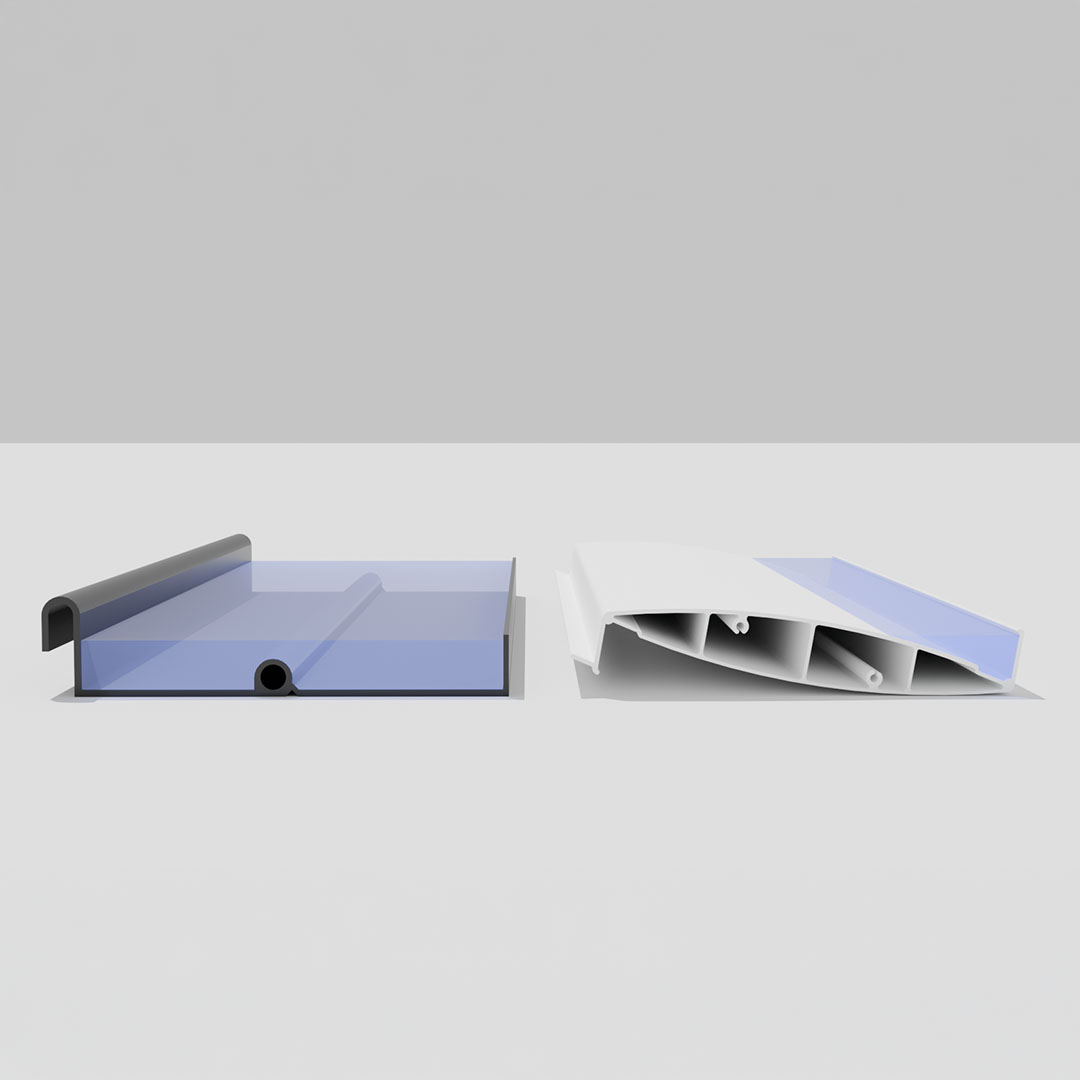
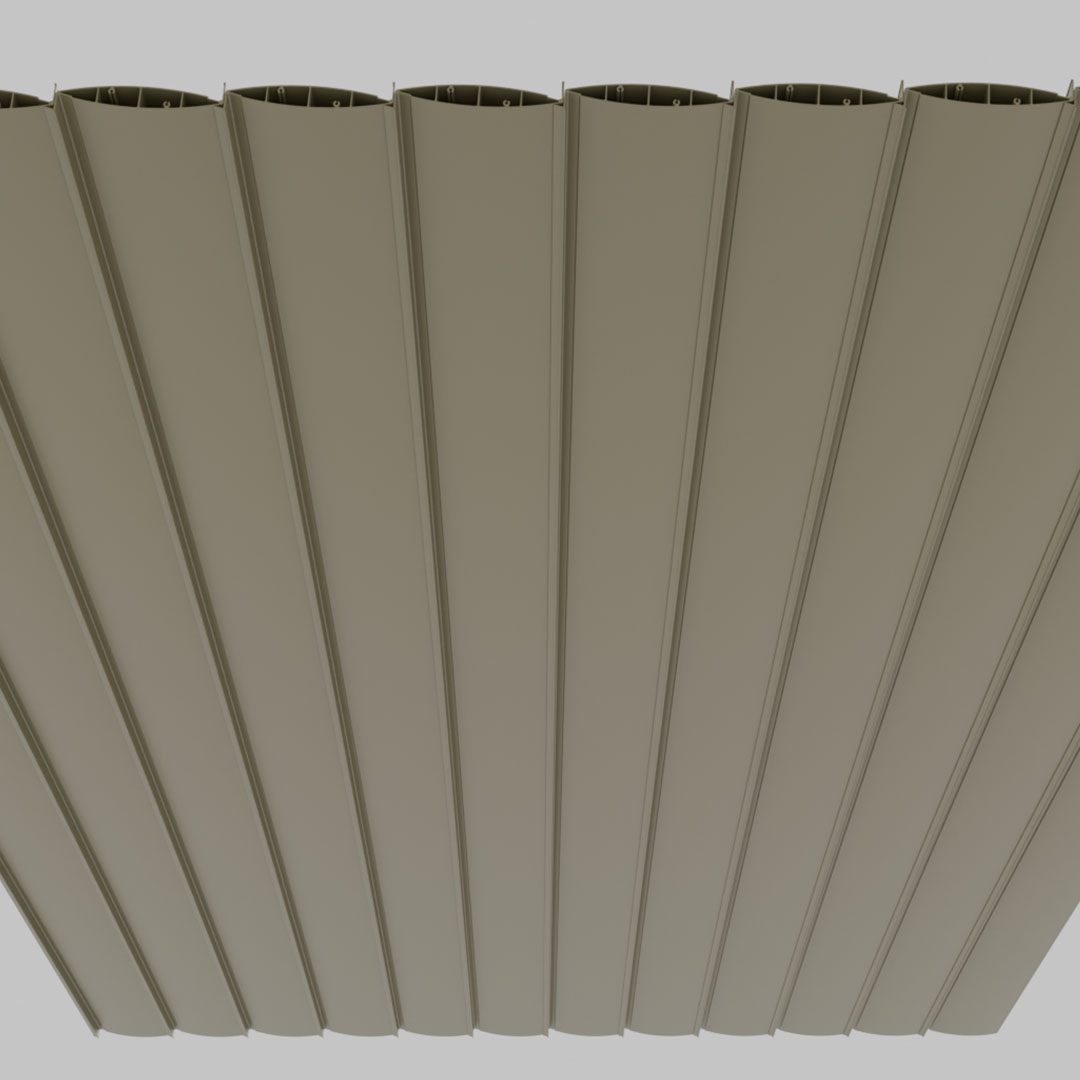
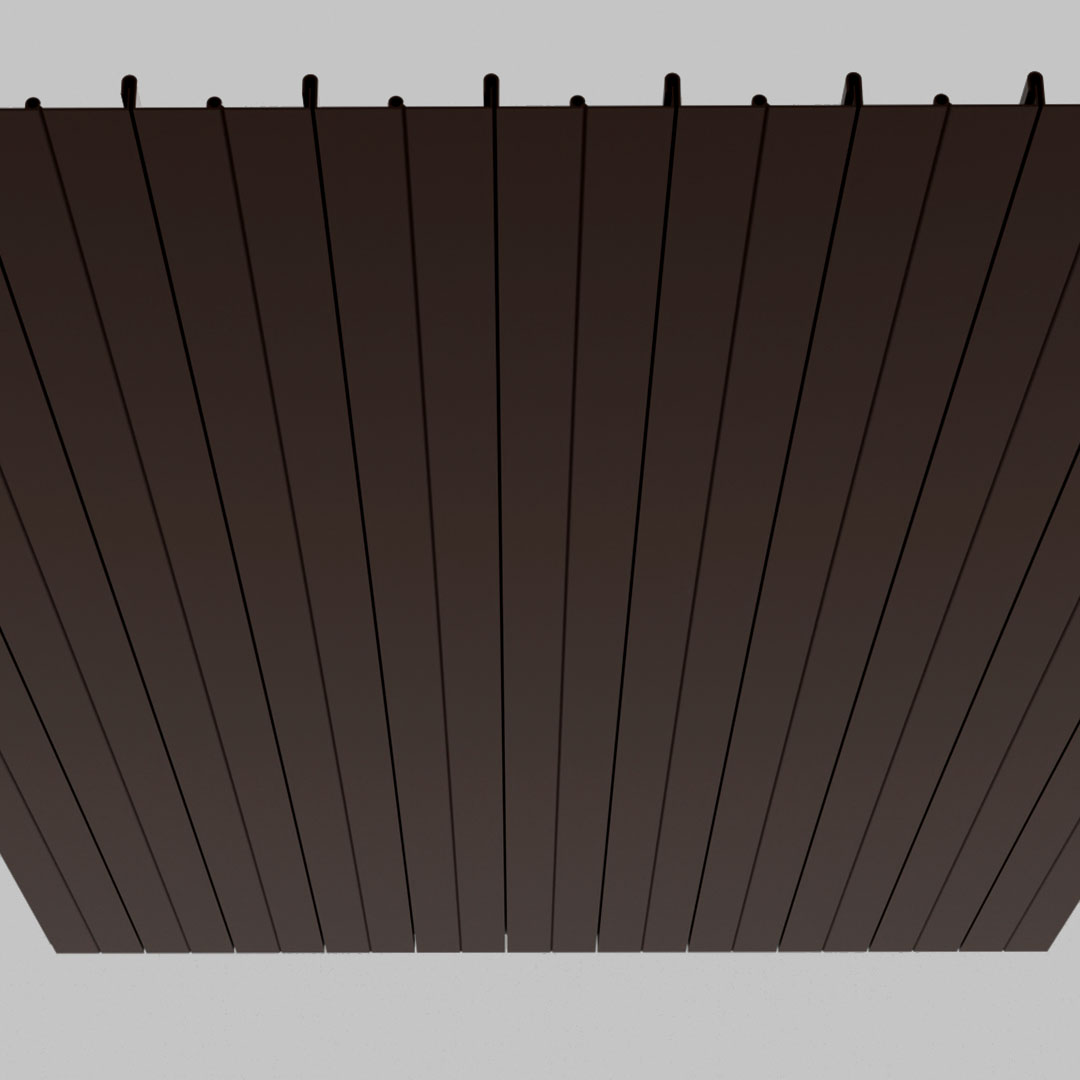
Both blades in cross-section, ours on the left and Equinox on the right. Ours is a solid extrusion built to shed water and take impact; theirs is a hollow, double-walled blade built for insulation. Same width, two different goals.
Control
Control & automation
Run it from your phone, and let it look after itself
Run your roof from your phone or by voice, set schedules, and split a larger system into zones so one area opens while another stays closed. Both systems can do this, and both can run on Somfy, so smart control is closer to a tie than a real difference. The everyday distinction is what comes standard: we build on Somfy across the system, while Equinox ships with a GAMA handheld remote and adds app and voice through Bond Bridge Pro, with Somfy available on its linear-motor setups.
The roof also looks after itself when you are not home. Wind and cold-weather sensors move the louvers automatically: ours open in a freeze around 40°F so they do not lock up with ice, and Equinox opens near 37°F for the same reason. Either way, the roof reacts to the weather instead of waiting on you.
Both systems are also built to take the usual add-ons, fans, heaters, and screens, so you can close in a space and run it year-round. That is common ground, not a difference, but worth knowing if a fan or screen package is on your list.
Two places they do part. Lighting is built in on our side, integrated Elios recessed LEDs made for the system that dim to set the mood after dark, where Equinox treats lighting as an add-on accessory. Power runs the other way: Equinox offers a solar-powered option on its GAMA controls, which we do not, so if running without a wired circuit matters to you, that is a fair point in their favor.
Warranty
What each warranty covers
Both systems come backed by solid, multi-year coverage. They are written a little differently, so each one comes out ahead in different places. Here are the terms as written, with the stronger position in each row marked, so you can weigh what matters most for your project.
| Coverage | Apollo Opening RoofAs written | Equinox Louvered RoofAs written |
|---|---|---|
| Structure & frame louvers, posts, beams, gutters, tracks |
15 years: materials, workmanship and finish | 20 years: materials and workmanship |
| Finish / powder coat | ✓15 years, backed directly by Apollo, same clock as the structure | 20 years against chip, peel, flake and blister, through the paint manufacturer's pass-through warranty |
| Motor & electronics | ✓5 years | 3 years, parts replacement only |
| Transfer & registration | •Original purchaser only; register within 30 days | Original purchaser only; register within 30 days |
The companies behind them
Where each one is made, and how you buy it
Both systems are sold and installed through dealers, so the real differences here are the size and origin of the company behind each product, and the reach of its network.
Equinox
A large national manufacturer
Equinox is backed by a national manufacturer with a dealer network across North America. That scale brings broad availability and a long track record, a genuine strength if reach and size are what you want behind your system.
Apollo
Privately held, focused on quality
Apollo is a privately held company that has built custom extruded louvered roofs in California since 2011, focused on engineering, build quality, and service. Every system is designed and made for the project it goes on.
AFTER INSTALL
Who you reach when you need something
With Apollo, support traces back to the people who designed and built your roof, the same team that made it, so questions about your system go straight to the source.
Which one fits
Pick the product that matches your project
Choose Apollo if…
You want it engineered to your site
- You want a hybrid roof, louvered sections combined with solid insulated or flat-pan panels in one structure, not a single all-louvered surface.
- Your design calls for a cantilever with no posts in the run, or it needs to tie into existing steel or timber.
- You want a solid, water-shedding louver, a finished-ceiling look, and a quiet Delrin pivot.
- You want a 360° perimeter gutter on all sides with the downspouts hidden inside the posts.
- You want the longer electronics coverage and a finish backed directly by the maker, and engineer-stamped plans available when your project calls for them.
Equinox may fit if…
You want a proven standard system
- The longest structural warranty term is your top priority.
- An insulated double-walled louver blade, built to reduce heat transfer, is what you care about most.
- A solar-powered control option matters to you.
- An all-louvered roof covers what you have in mind.
Common questions
Apollo vs Equinox
What is the real difference between Apollo and Equinox?
They are close in category, but built differently. The clearest differences are the louver, the structure, and the warranty. Apollo uses a solid single-extrusion blade that pivots on Delrin pins for a quiet, finished-ceiling look; Equinox uses an insulated double-walled blade on pivot strips, built to reduce heat transfer. Apollo can also be engineered into shapes a pure louvered system does not offer, like cantilevers, integration into existing steel or timber, and hybrid roofs that mix louvers with solid panels. On warranty, the two lead in different places, broken down in the warranty section above. Same category, genuinely different priorities.
Why don't you publish a price?
Because there is not an honest single number to publish. Every Apollo system is custom designed for the space and installed by a certified dealer, and dealers quote their own market. Equinox is also custom-sized and dealer-quoted, so neither of us posts a fixed price. The right way to get a real figure for your project is to design it and talk to a dealer.
Both use 8" louvers, so what is actually different?
Mostly how the blade is built and what is engineered around it. The blade: ours is a single solid extrusion, flat and shaped to shed water and built to take impact, where theirs is a double-walled blade aimed at insulation. The pivot: ours rides on reinforced Delrin pins with no metal-on-metal contact, theirs runs on pivot strips driven by a gear or linear motor through a link bar. And the structure: we can build cantilevers, integrate into existing steel or timber, and mix louvered sections with solid insulated panels in one roof, then drain it through a 360-degree gutter with downspouts hidden in the posts. Same louver width, different engineering around it.
What can you build that Equinox can't?
Equinox is genuinely customizable too, so this is narrower than it sounds. They size to your space, wrap corners, work at angles, and do L-shapes. What we add is structural: true cantilevers with no posts in the way, integration into existing steel or timber, and hybrid roofs that combine louvers with solid insulated or flat-pan panels in one structure. An all-louvered system gives you one surface; ours can mix louvered and solid where you want each.
How do the warranties compare?
It is a genuine split. Equinox warrants the structure for 20 years against Apollo’s 15, and covers labor and shipping in the first year where Apollo does not, so on the headline term and an early failure Equinox is stronger. Apollo covers electronics for 5 years versus Equinox’s 3, and backs its finish directly for 15 years rather than routing it through the paint manufacturer’s pass-through warranty. Both run to the original purchaser only, and neither warrants the roof being fully weather tight.
Is it really waterproof when closed?
Our roof is built to be watershed, not waterproof, and that distinction is an honest one for any louvered roof. When the louvers close, the blades and the 360° perimeter gutter direct water away and off the structure, with the downspouts routed down through the posts. Equinox markets a watertight seal when closed, though their own warranty does not cover weather-tightness, so it is worth reading that claim against the coverage behind it. The honest expectation for either system is that in heavy, wind-driven rain some water can still find the seams. Watershed handles real weather and keeps your space usable, which is what a louvered roof is built to do.
Is the insulated Equinox blade cooler underneath?
That is the real upside of their double-walled design, it is built to slow heat transfer through the louver, so the underside can run cooler in direct sun. Our solid blade is built for strength, water-shedding, and the finished-ceiling look instead. If a cooler underside in peak sun is the single thing you care about most, that is a fair point for Equinox. For most setups, shade from the closed roof and good airflow matter more than the blade itself, but it is an honest trade worth knowing.
See your space, your way
Design your system online in minutes, then connect with a certified dealer to make it real. Louvers made smart, built for custom spaces.
Made in California since 2011 · Custom-designed
· Engineer-stamped · Certified installers